Siemens&Halske T68d
Status: Working and connected to i-Telex
Note
You can find more detailed mechanical descriptions (in german) in my thread T68D Wiederbelebung on telexforum.de
Intro
The T68d is a historic 50-baud tape-type teletype device from a former german company called Siemens & Halske. The particular device I bought on ebay with serial number 8L5239 was presumably build 1955 in my hometown in the former Wernerwerk für Telegrafen- und Signaltechnik, Hofmannstraße 51, Munich. According to the internal answerback unit and the historic database of the iTelex community, it was lastly used by a company called Auskunftei Buergel Centrale GmbH Wuppertal, which was some sort of credit agency.
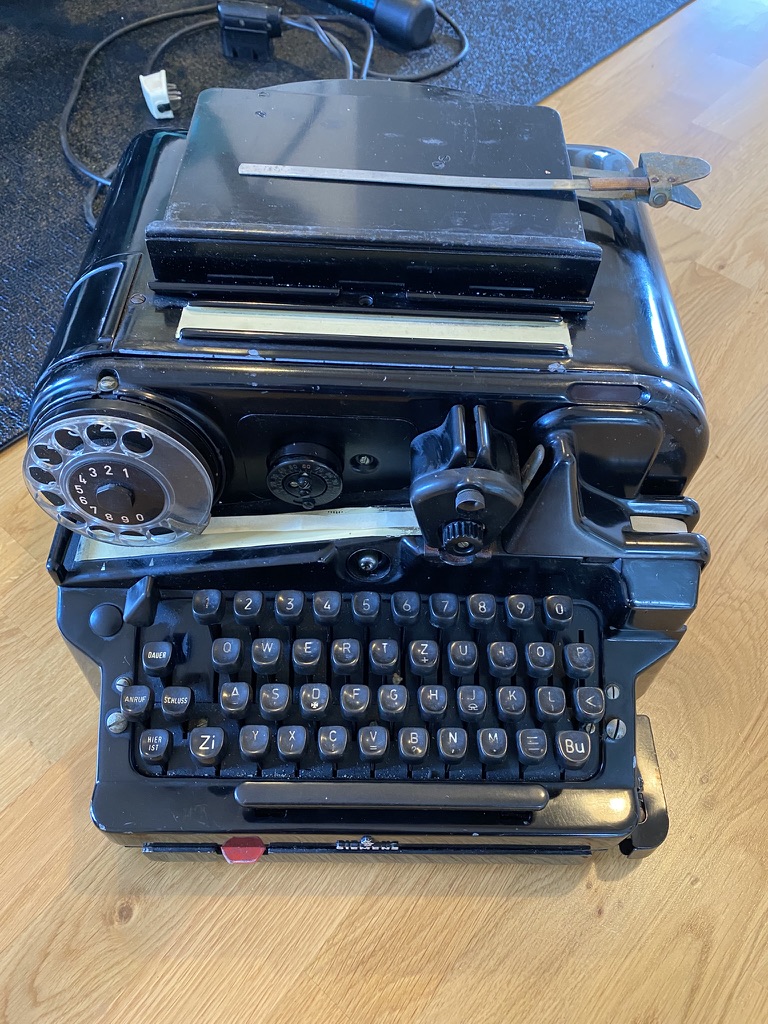
The device was available in different configurations. Mine unfortunately came without a hole punch and without a tape reader. It only has one paper reel drawer for printing.
My device came in a rather good shape, so I was pretty optimistic to get it running again.
Finding technical documentation
...was unexpectedly easy-peasy. It turned out there is a huge nerdy community in Germany when it comes to old telecommunication technology. I found various documents (operational and service manuals) for the device on telefonanleitungen.de (account required to download the docs).
Cleaning
After opening its black metal casing, shards of red glass were tumbling out of the intricate inner mechanics. It turned out, that there originally was a red incandescent light bulb inside that was broken during shipping. The light bulb was used as a warning light when only a few remaining characters are left. This was especially useful if one was connected to a proper paper-printing teletype. Then you knew, that you're about to reach the end of the paper and you have to send a carriage-return (CR) and line-feed (LF) character. The keyboard even got blocked when you reached the maximum amount. Unlocking was then done by sending a CR.
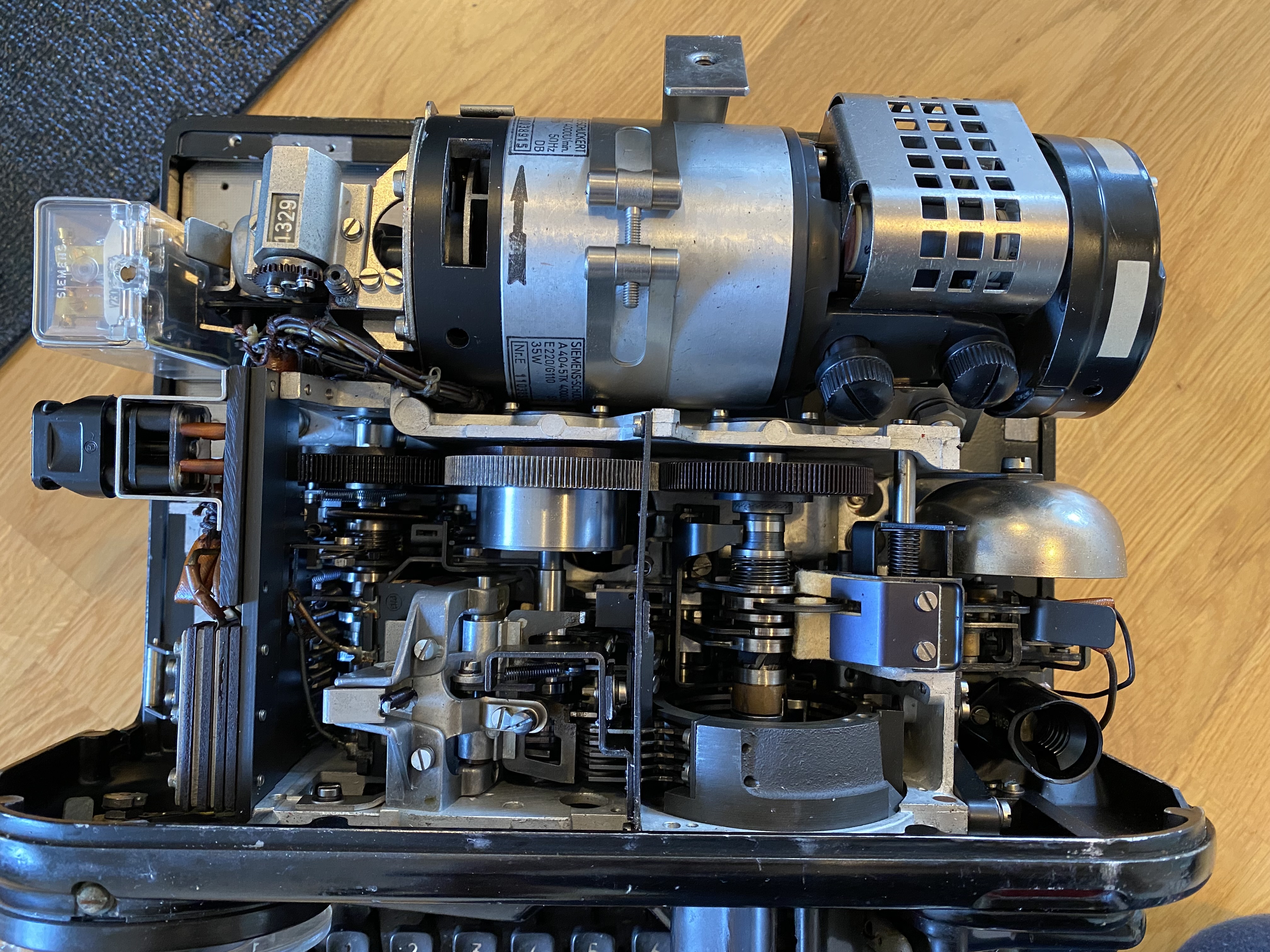
I gave it a shake and thoroughly vacuumed off all sheds (Pro tip: attach a straw to your vacuum cleaner to reach narrow spaces  ). After that, I lubricated every piece that might potentially move with sewing machine oil. I also cleaned off the gunk on the printwheel with white gas and a toothbrush.
The printwheel is continuously getting inked by two felt rollers, who dried out over time. I got an excellent tip from the telexforum to let them soak in WD-40 overnight, then clean them with white gas and finally let them soak in black oil-based stamping ink. The result was astonishing.
Electrical safety
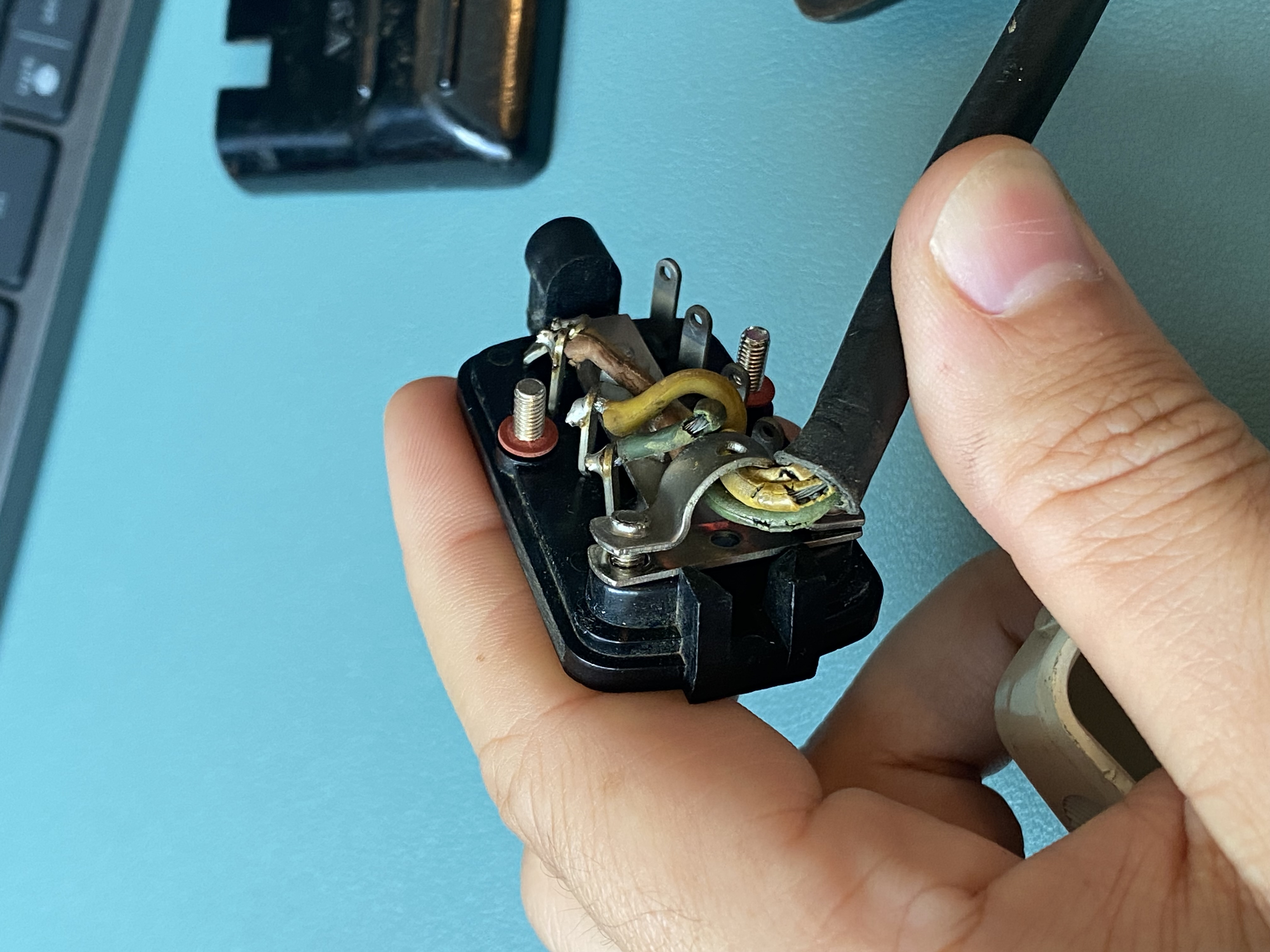
Another quite excellent tip from the community was to have a closer look to the mains voltage part before powering it up. Two commonly known problems of this device are:
- The mains EMI filter 'Fe2' tends go up in a puff of magic smoke. So I simply removed it from the equation with a wire cutter for the time being.
- The cables might look good on the outside, but the inner isolation is usually in a poor condition. Therefore I replaced both the power cable and the teletype cable.
Powering & first test
At this point I was really impatient to turn on power to see if it works. I had to buy another lab power supply, since my old one just goes up to 30V. For teletype devices you need (at least) 60V. But numbers you will find on the internet even range from 60V to 120V. It turned out that Siemens&Halske T68d also requires a little bit more, so it went with around 80V-90V.
As teletype devices need a 40mA line current, you have to restrict the flow of current! Therefore I used my lab power supply in 80V constant-voltage (CV) and 40mA constant-current (CC). It worked fine for the T68d, but later I learned that the switching from CC to CV and back is quite slow on my lab supply. This heavily distorts the edges in the digital signal and introduces strange spikes and overshoots. The T68d was fine with it, but other teletypes (like my Lorenz Lo15) might print garbage. You also have to take care about polarity: My T68d comes with a Fernschaltgerät (FSG) which a device for dialing and switching on the motor. Depending on the polarity of the line current, the T68d is eiher in idle state or active state. The exchange switches polarity to indicate an established connection, which then turns on the motor. So you have to find the right polarity for the motor to turn on.
Unfortunately, on the first test it showed several mechanical issues:
- The paper tape advance mechanism did not work correctly. The tape was only moving sporadically.
- Even if it tried to print something, no characters where actually printed on the paper tape.
- Switching the typewheel between letters and numbers was not working.
- It was constantly trying to print something, which shouldn't be the case. The motor should be running and it should only print something, when you type on the keyboard.
Deep dive into the abyss of german compound words
As written above, I had access to detailed service manuals. The one I mostly refered to was the Einstell- und Ölvorschrift. It has beatiful and detailed drawings of each and every mechanism. However, even if you're a native german speaker and an engineer, it's really hard to read and to understand. That pile of paper is a nightmare of mechanical and archaic german compound words and cross-references. Just to give you an example:
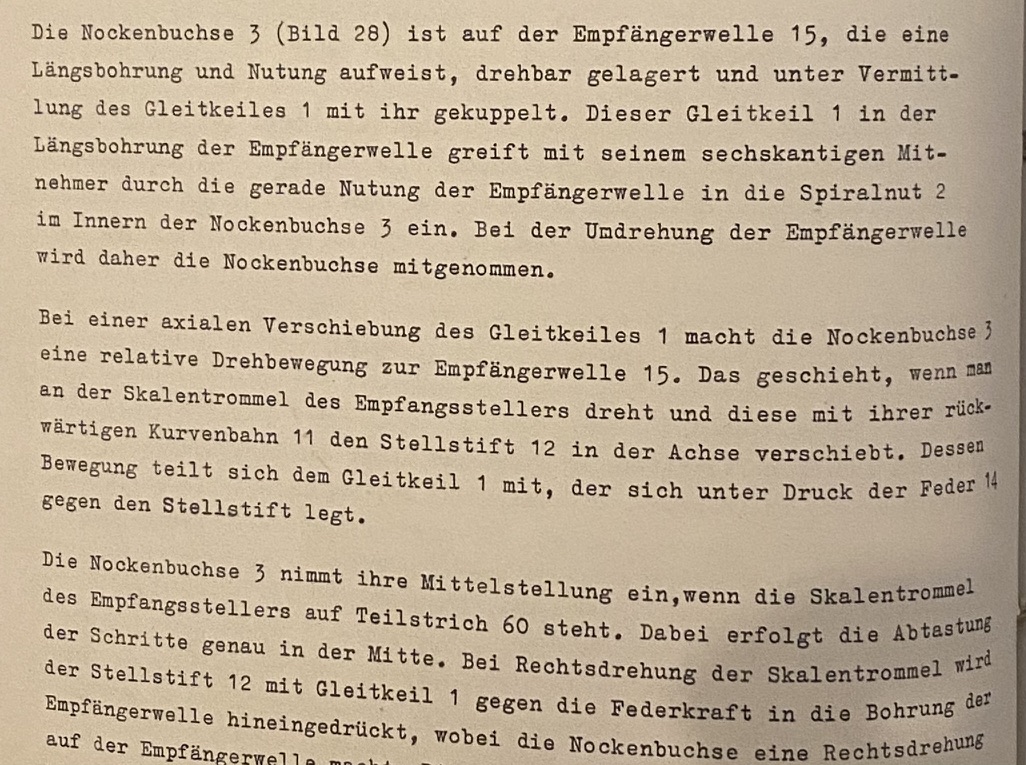
The middle paragraph translates into something like this:
When the sliding wedge 1 undergoes an axial displacement, the cam bushing 3 performs a relative rotational movement with respect to the output shaft 15. This occurs when the scale drum of the receiver actuator is turned, and its rear cam track 11 shifts the adjusting pin 12 along the axis. This movement is transmitted to the sliding wedge 1, which is pressed by the force of the spring 14 against the adjusting pin.
After several mental breakdows however, I was able to solve the mechanical issues:
- The small wheel which is advancing the paper tape just needed a thorough clean and some WD-40.
- The little plunger, which bashes the tape against the type wheel was rusted in place. Dismantling the mechanism and cleaning everything with WD-40 solved the issue.
- The levers for switching between letters and numbers had the same rust problem.
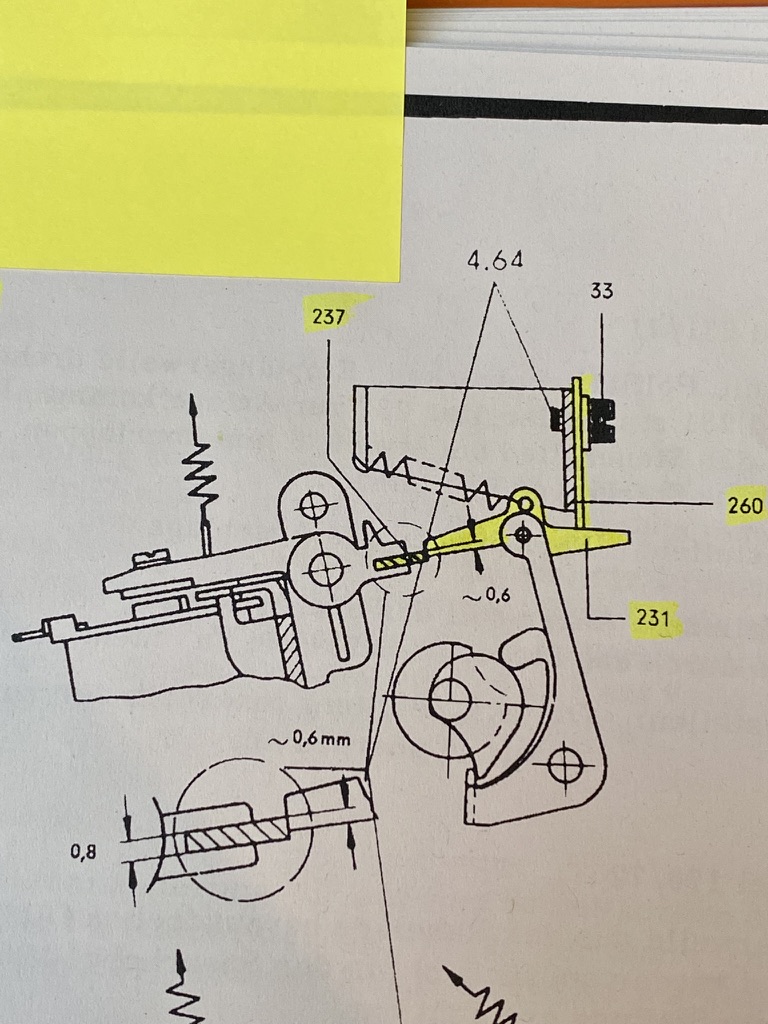
- The problem that it was constantly printing stuff after turning on the power was a bit harder to solve. The locking mechanism, which is stopping the anchor of the receiver magnet to be actuated was slightly misaligned. I was able to re-adjust it with the help of the following drawing in the pile of paper:
It finally works!
After solving all mechanical issues, it was finally in a working state again. As I ran out of the remaining original paper tape, I had to find a proper replacement. I simply bought white paper streamers on Amazon, which works quite well (even though they are a bit smaller than the original paper tape). In the meantime, I was able to buy proper paper reels from a member of the telexforum.
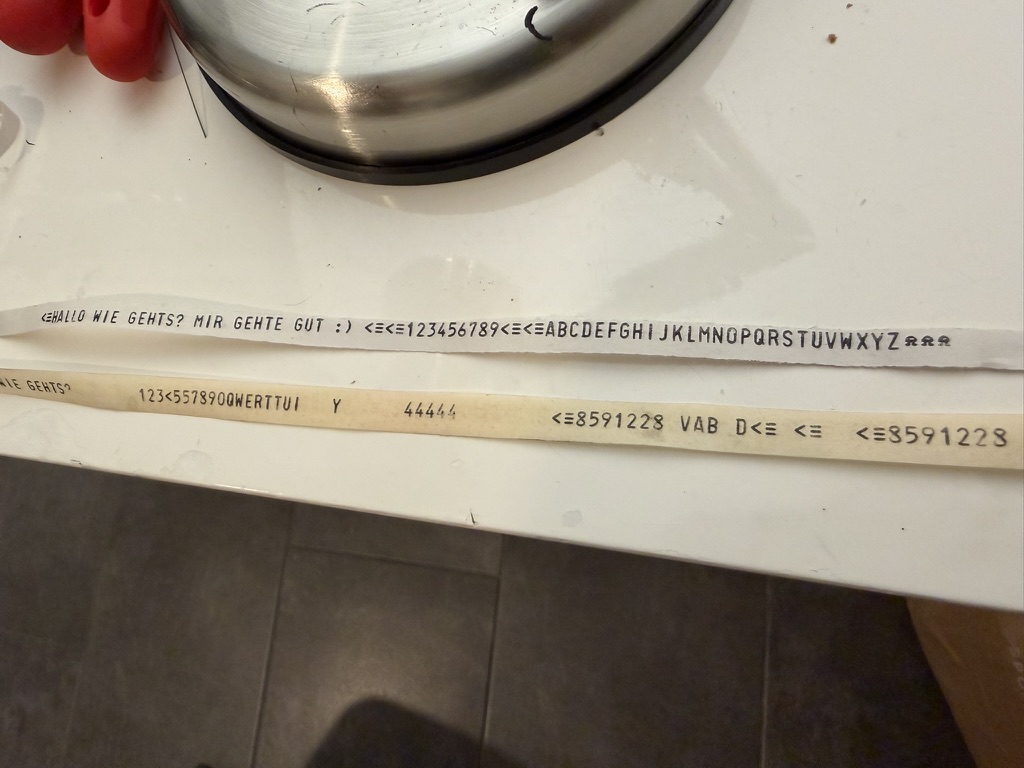
I also build a piTelex device using a Raspberry Pi, to connect my T68d to the i-telex network over the internet (article coming soon). With this, it is actually possible to send and receive telegramms from other nerds. My number is 8591228 VAB D.